


Last month, two of us packed our bags and headed to Barcelona. Not for tapas (though there was some of that too), but to present the Open Home Foundation's first-ever peer-reviewed paper at ACM CHI – the leading international conference on Human-Computer Interaction 🎉
It was a milestone we'd been working toward for a long time. By publishing and presenting this research, we're putting evidence on the academic record that privacy-conscious users exist, and their needs are real and underserved. It reinforces one of our core beliefs: that smart homes need to be designed with privacy at the foundation, rather than something users have to retrofit.
But the paper is only part of the story. Behind it is a rigorous approach to research that shapes our work at the Open Home Foundation. In this post, we'll dig into our methods, what we're currently investigating, and why we think research and community go hand in hand.
From principles to a peer-reviewed paper
Privacy is one of the core principles of the Open Home Foundation. So when the opportunity arose to explore the topic in a formal study, it felt like a meaningful place to start. Building a Private Smart Home: User Motivations and Challenges – the paper Annika and Open Home Foundation President Paulus Schoutsen co-authored – investigated how privacy shapes the way users set up and maintain their smart homes. Specifically, what measures they take to ensure privacy in their homes, and what aspects of smart home tech make users uncomfortable due to privacy concerns, including when that might lead to them abandoning certain (big) technologies.
What the research illuminated was that privacy concerns in the smart home don't exist in a vacuum. Users are responding to a broader landscape, rife with data breaches, surveillance capitalism, AI trained on personal data, and data tracking for political gain. The desire for more private systems is real, and for many, it's already driving them away from technologies that don't meet that standard. That's exactly why we exist as a foundation: to fight for locally controlled, private smart home alternatives that put users back in control.
Presenting that work at ACM CHI meant bringing it to an event of more than 6,000 people: researchers, manufacturers, academics, and community members who care just as deeply about the future of smart home technology as we do, including many fellow Human-Computer Interaction (HCI) researchers – the field in which we both completed our PhDs. HCI is a discipline concerned with designing technology around human behavior, needs, and values: exactly the lens we bring to our work at the Open Home Foundation. We had rich conversations with people working across domains that feed directly into ours: privacy within IoT systems, bystander privacy for visitors and guests, prevention of technology-enabled violence in smart homes, family-centric smart home design, and more. That exchange of ideas – across disciplines, perspectives, and areas of expertise – is what these conferences are all about. And it doesn't stop in Barcelona.

Scenes from ACM CHI 2026 – from keynotes to the conference floor.
Whether you're a researcher, a community member, or just someone who cares about privacy in your smart home – we'd love to hear from you. Head to our UX design discussions page on GitHub to share your insights (we read everything!). And if you'd like to go deeper into the research itself, check out the full paper and research wiki, or if you only have a few minutes, take a peek at the poster we presented at the conference 👀
Why we question what we build
Research is one of the ways we ensure what we build solves a problem for the people who will actually use it. By making decisions that are informed by evidence instead of instinct, we not only reduce risk, but keep ourselves accountable to the people we're building for. Which brings us to a larger goal that's at the heart of everything we do: making sure what we create is genuinely human centered, not just technology centered (spoiler: it's harder than it sounds).
It's an iterative process that involves figuring out the right questions to ask, speaking to a broad range of people, and being honest about our biases and gaps in understanding. For example, being aware that our community doesn't represent our entire user base. The people who are active and vocal in our forums and discussions are invaluable, but they're also a small share of our users and we can't generalize their needs and opinions to everyone. That's why good research makes sure those other voices are heard, too. Because by getting a fuller picture of who users are and what matters to them, we're better placed to find real problems that smart home technology can solve.
Ultimately, every question leads back to you. But who's doing the asking?
Meet the people behind the work
Our work spans two interconnected areas: understanding the smart home landscape and the people within it.
Idil's focus as a Market Researcher in the Marketing department is how the smart home landscape is shifting, how people outside our community perceive and relate to our projects, and how we can better identify and serve the needs of the people already with us. With a background in cognitive neuroscience and doctoral research in healthcare technology, Idil has a particular interest in the growing convergence of home technology and personalized health, and what that means for how we design for people, not just devices.
Annika works within the Product & UX department to understand what users actually want and need: who a new feature is for, what needs it addresses, and what aspects of the user experience need attention before it ships. Annika's PhD focused on cohabitation in smart homes – specifically what happens when one person sets up and maintains the technology, while the other person lives with it. The research investigated the dynamics of shared households, including the power imbalances that can emerge, and how couples negotiate control.
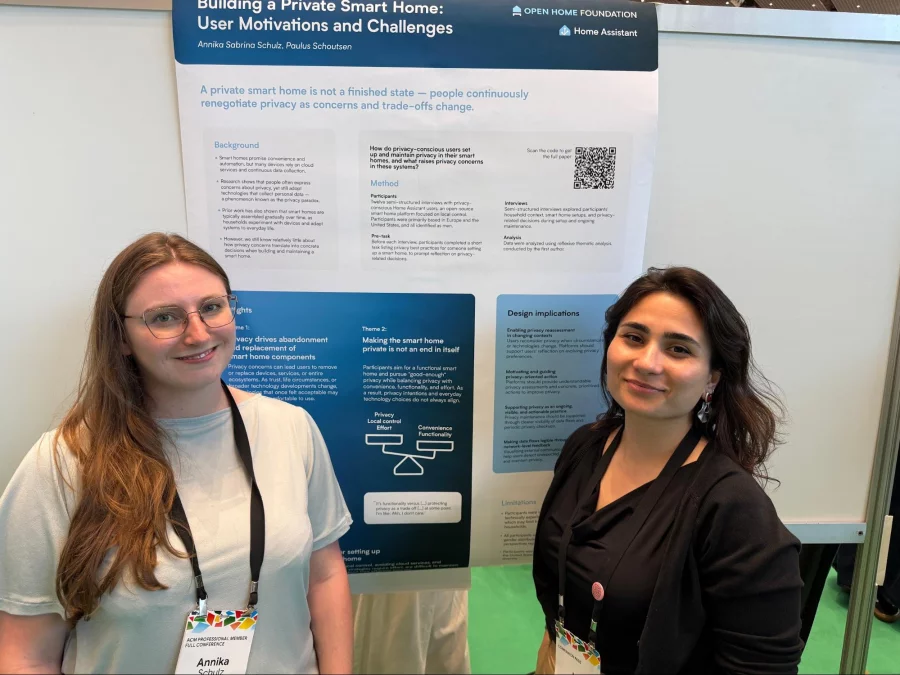
Annika Schulz (left) and Idil Bostan presenting Open Home Foundation's privacy study poster at ACM CHI 2026 in Barcelona.
What unites our work is a shared belief that technology should be designed to be approachable to everyone. Our Product Manager Laura Palombi captured this perfectly at State of the Open Home 2026: "Approachability means thinking as a human is thinking and not as the machine wants you to think".
The question is how we actually understand what our users think, especially when our commitment to privacy rules out the research methods most tech companies take for granted.
Built on consent, not cookies
Let's address the elephant in the room: data. Research at the Open Home Foundation is shaped by a core tension: we want our projects to be grounded in evidence, but we won't sacrifice our values to get there.
This pushes us to seek privacy-sensitive data collection methods for understanding our users and informing decisions. We're crafting approaches designed to respect the community. For example, when conducting research, participants are explicitly asked to share information about themselves, their perspectives, opinions, and experiences based on informed consent – as described in our User Research Agreement. Translation: we want people to share on their own terms, and know their privacy is protected in the process.
While our approach can add challenges, meaningfully contributing to ethical research methods in service of our community, especially in the world of tech, is more than worth the effort.
Research in action
And it's this commitment to ethical research that has shaped our work from the start. Our research on the automation editor – a tool that lets you create and edit automations directly from the Home Assistant user interface, without writing any YAML code – explored how users actually interact with one of Home Assistant's most-used features. And our research into how privacy-conscious users build and maintain their smart homes evolved into the study we presented at CHI.
That work doesn't stop. Right now, we're investigating user expectations of the Works with Home Assistant (WWHA) badge. Because some WWHA-certified devices have features missing in Home Assistant, we want to understand what users expect from the badge so we can align our certification decisions with that. This will also help us work out how to communicate any limitations so users can make genuinely informed purchasing decisions.
We're also conducting several studies in parallel, in which we ask questions about the work and field of professional smart home installers, learn from beginners about how we can help them find their footing in ESPHome, and observe how users familiarize themselves with the Dashboard Creator of Home Assistant.
All different questions, all driven by the same commitment: to make sure your input shapes what we build. And we want more people to be part of the discussion.
Join the conversation
From our work in Human-Computer Interaction, we know Home Assistant has already become a research tool in its own right, used across domains as a flexible way to build prototypes and integrate newly developed technologies into real setups (it's actually how Annika found her way to Home Assistant in the first place!). That crossover between practice and academia matters to us. Outside perspectives challenge us to think beyond what already exists, and that ultimately means more thoughtful technology and more choice for you – which is exactly why we want to stay connected to the people doing that work.

The wider community we're proud to be part of – CHI '26's academia-practice divide meetup.
If you're a researcher working on smart home usage, interaction design, privacy, accessibility, or anything adjacent, we'd love to hear from you. We've set up a dedicated space on GitHub where you can share your work and start discussions: a place to exchange ideas, follow each other's work, and think together about what comes next.
The best version of smart home technology gets built when practitioners and researchers are in dialogue. Come be part of it!